The first week 45 entry went out on Wednesday. Then Thursday and Friday happened, and they shipped more than Monday to Wednesday did. So week 45 gets a second page. If you want to know what the system is and how a client plugs into it, read how I work first. This page is the changelog, not the brochure.
Nask AI: fix the spot, not the ad
Nask AI is the engine that turns a founder’s own words into ad volume. Every change below reached every client the day it merged.
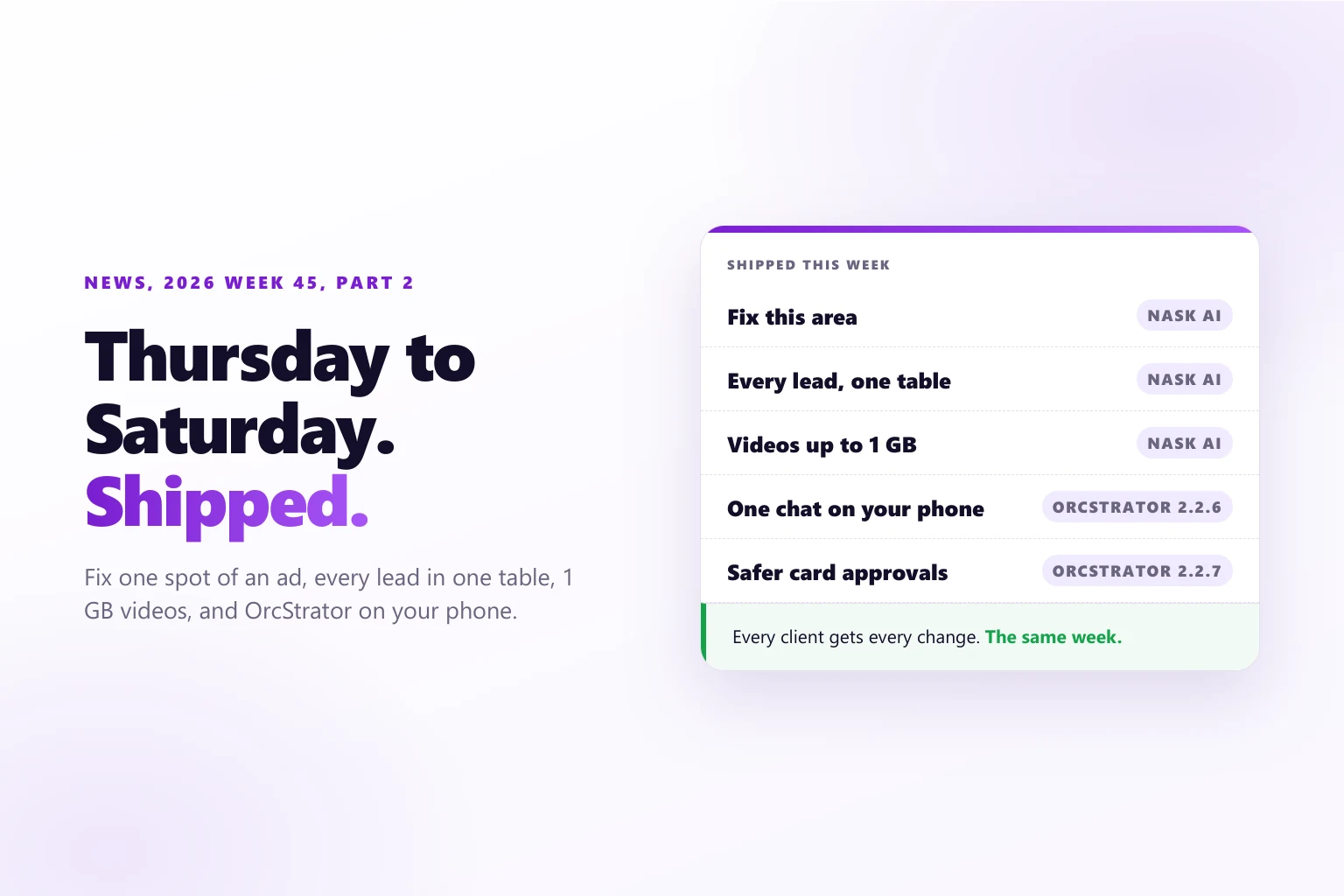
- Fix this area. In review, you can now draw on an ad, type what is wrong, and only the part you circled changes. Before this, one wrong hand meant regenerating the whole ad and hoping the new one kept everything you liked. Hope is not a workflow.
- A newer image model by default. New runs use it on both the Fast and the Quality setting. Old runs stay on the model they were made with, so nothing you already approved quietly changes under you.
- Every lead, one table. The Leads page now shows every lead from every site the Nask AI pixel sees, not only the pages Nask AI hosts. The same submit caught twice shows once. Phone-only forms count. Bookings from Calendly, Cal.com and GoHighLevel arrive as lead rows. A daily check now warns me if Meta ever starts counting a lead twice, before a client’s numbers do.
- Long videos. Upload & Publish now sends videos up to about 1 GB to Meta in chunks, and an interrupted upload picks up where it stopped. A long-form cut is a normal ad now, not a support ticket.
- One kind of Meta connection. Every brand now connects to Meta through a business connection. Personal logins are gone from the product. Fewer ways to connect, fewer ways to break.
In testing: the campaign that builds itself
The rest of Nask AI’s week sits behind an admin switch while I test it on my own accounts.
- Auto-Deploy. A brief plus one recipe becomes a full campaign: the ad sets, the ads, the budget and the kill checks at 48 and 96 hours. Every ad passes a check for invented claims before a single image credit is spent. An ad that fails gets two more tries, then the run stops instead of improvising.
- Video engines. One edits an existing video, one spins a single video into variations cut on the real words, and one gives the voiceover the brand’s own voice. Plus animated ads with music, as a GIF and a looped video.
When they are boring enough to trust, they go to everyone.
OrcStrator: one chat on your phone
OrcStrator is the app I run my agents in, all day, every day. Two releases went out on Friday.
- 2.2.6. Questions from the agents now arrive in the same phone chat as everything else, so there is one bot to set up. Type a word with a hashtag and a message from your phone, and the card that listens for it runs with your message as the instruction. Agents can update their own cards, every edit can be undone, and the ones running unattended wait for an Approve tap. Backup now saves settings, project files and past chats, and Restore shows what it will replace before it does.
- 2.2.7. When an agent edits its own card, the approval shows every change in full, and any hidden or look-alike character is named one by one. If an edit is too long to read on a phone, the phone sends you to the app to read all of it. Every finding from the release security check was fixed before it shipped.
One more, off the product: all three sites (this one, nask.ai and orcstrator.com) now have a how it works page, an about page and a /news page like this one, all pointing at one author: me. The six explainer posts on this site now link to each other, so a reader who lands on one can find the rest.
That is week 45, all of it this time. Same time next week.