
Key takeaways
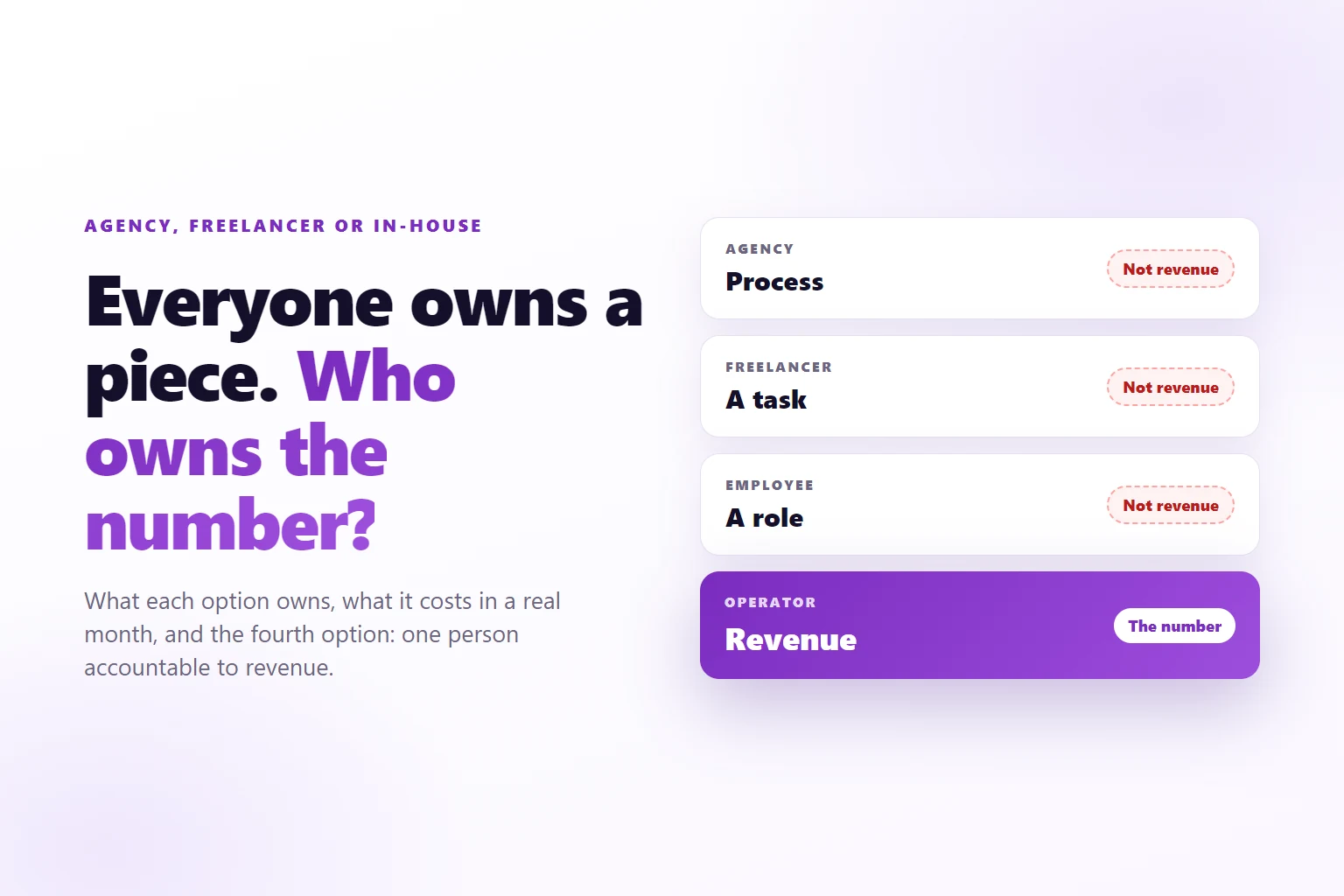
- An agency sells process, a freelancer sells a task, an employee sells a role.
- The gaps between three providers are where most budgets leak.
- Ask each option who is accountable when leads arrive and sales do not.
- The fourth option is one person who owns the whole stack and the number.
Choosing between a marketing agency, a freelancer and an in-house hire is a choice about who owns the result: an agency owns process, a freelancer owns a task, an employee owns a role, and none of them by default owns revenue.
Your marketing is a patchwork. A freelancer built the site. An agency runs the ads. The CRM belongs to whoever set it up and left. Leads come in, the sales team says they are bad, the agency says the sales team cannot close, and you are the only person in the building who sees all three pieces. Now you are deciding whether to fire the agency, hire a freelancer, or bring someone in-house.
Every page that ranks for this question is written by someone selling one of the options. The agencies conclude you should hire an agency. The freelance marketplaces conclude you should hire a freelancer. I sell a fourth option, so I am not neutral either. The difference is that I will show you the table I put on my own services page, including the rows where the other options beat me.
Agency
Owns: ProcessFreelancer
Owns: A taskEmployee
Owns: A roleWho this is for
This is for the founder of a business with paying customers, doing $100,000 or more a month, with a sales team taking calls. You have tried an agency or a freelancer, maybe both, and the question has stopped being “who runs the ads” and become “who answers for the revenue”.
If your business does less than about $20,000 a month, most of this does not apply yet. At that stage the cheapest option that ships is usually the right one, and the founder owning the number is normal.
This is also not about brand awareness. Every option below is judged on one question: when leads arrive and sales do not, who is accountable?
What does each option actually own?
Each option owns something different, and none of them owns revenue unless you write it into the deal.
Here is the table from my services page.
“Freelancers” means five people, because that is roughly how many specialists it takes to cover the stack: ads, creative, copy, pages and tracking. “An agency” is a company. “Advisory CMO” is an advisor: a senior marketer who tells you what to do and does not do it. CMO means chief marketing officer.
The row that matters is “Accountable for”:
- Freelancers: tasks done. The landing page shipped. The ads went live. Whether either one made money is not in the brief.
- An agency: PDF reports. The agency owns its process, and the report is the proof the process ran. Clicks, impressions and cost per lead go up and down in it. Revenue usually does not appear.
- Advisory CMO: nothing. Advice is the product. If the advice is right and nobody executes it, the result is still zero.
- Me: revenue. That is the column I sell, and the case below is how it gets measured: money in the bank, not activity.
The table concedes ground on purpose. The agency beats freelancers on ad volume: 100 ads a month against 50, even though the freelancers ship more pages. The advisory CMO wins strategy outright. Freelancers win cost.
The “Strategy” row is the one founders skip. With freelancers, the strategy is you. With an agency, strategy is extra, a separate line on the proposal. If you are already the strategist, the CMO and the project manager, count those hours as part of the price.
What does each option cost in a real month?
The fee is never the whole month. Every option needs an ad budget on top, so compare them all-in.
These are the ranges I quote on my services page, against my own published prices:
- A mid-tier agency: about $3,000 to $5,000 a month in fees.
- One marketing hire: about $6,000 to $8,000 a month, and it ramps for about three months before it runs at full speed. The O*NET wage data for marketing specialists puts the 2025 median for market research analysts and marketing specialists at $78,760 a year, which works out to about $6,563 a month (my division, not theirs), inside that range.
- A senior in-house marketing manager: the O*NET wage data for marketing managers puts the 2025 median at $166,790 a year, about $13,899 a month (again my division).
- Freelancers: the lowest invoice on the table, paid per task. The hidden line is your own time running five people.
- An advisory CMO: the highest on the table. Senior consultants in my market charge $1,000 an hour and up, and the hands to execute the advice are a second bill.
My Revenue Machine plan is $2,900 a month, needs at least $5,000 a month in ads, and adds 10% of ad spend above $10,000. So $2,900 plus $5,000 in ads is $7,900 a month all-in. Hands-On CMO is $9,000 a month with a $10,000 ad minimum. Every plan is laid out with how the one-person model is priced.
Put the same $5,000 ad budget on the agency and the hire, and the all-in months come to about $8,000 to $10,000 for the agency and $11,000 to $13,000 for the hire. Those totals are my arithmetic on the ranges above, not quotes.
An employee also costs more than the salary. The SBA guide to hiring employees lists what comes on top: employers pay Social Security taxes at the same rate as their employees, workers’ compensation is required, and state employment taxes often add unemployment and disability insurance. The salary is the number on the offer letter. It is not the number on your books.
Where budgets leak: the gaps between providers
Most budgets do not leak inside any one provider. They leak in the handoffs between them.
When the agency and the sales team sit in separate silos, you get the same fight every month. The agency says the closes are horrible. The sales team says the leads are shit. Both are partly right, and neither one answers for revenue. Each provider is graded on its own piece: the site on how it looks, the ads on cost per lead, the sales team on closes. Nobody is graded on the line that runs from the first ad to the money in the bank.
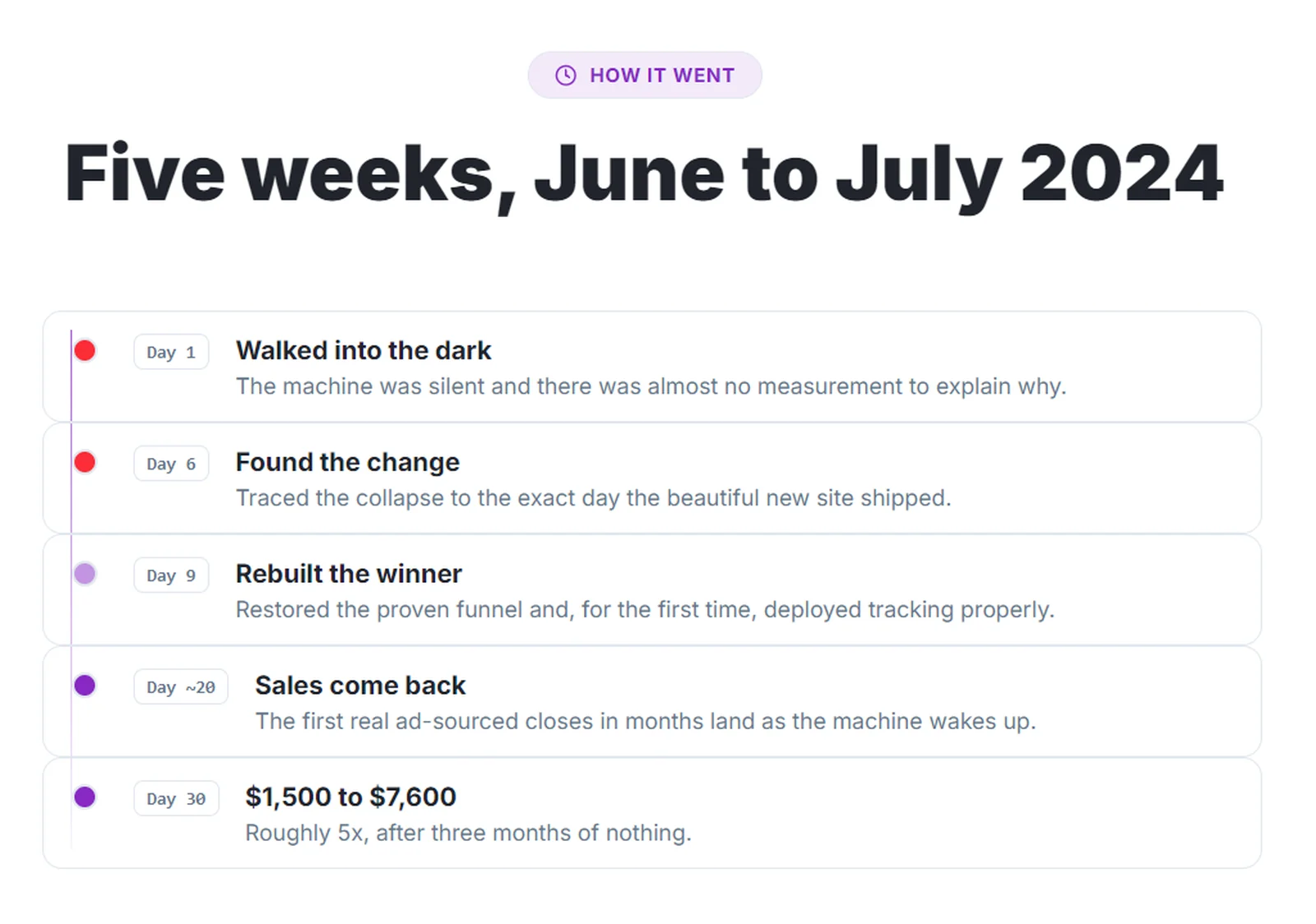
An in-home personal training business had one paid-ads funnel that booked assessments on repeat for years. Then the business rebuilt its website into something stunning, and the day it went live the funnel stopped. Three months, almost no sales.
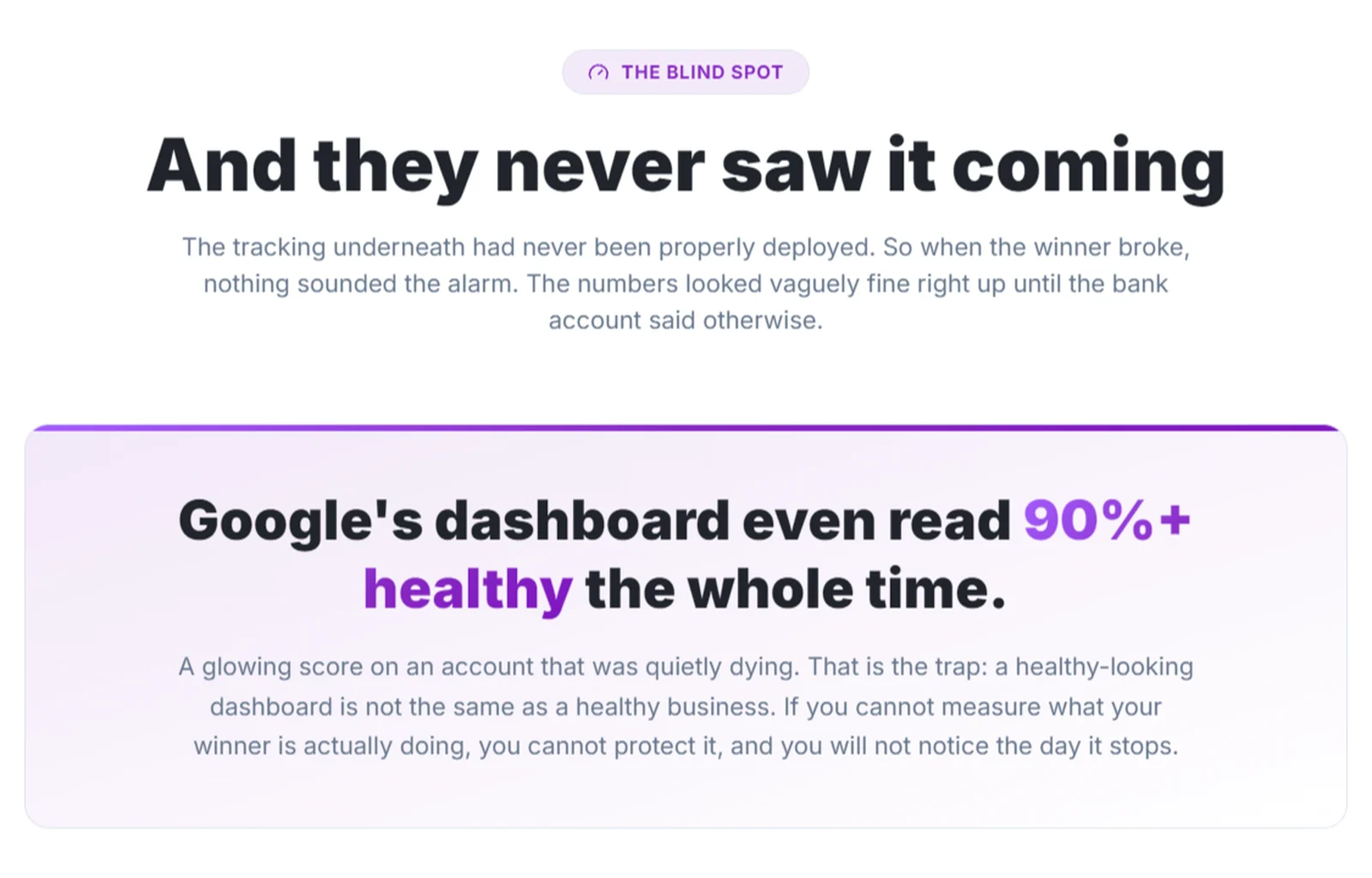
Nobody had done anything careless. The new site was better looking than the old one in every way. It quietly replaced a proven funnel with an unproven one. The tracking underneath had never been fully deployed, so nothing sounded the alarm. Google’s dashboard, the one that scores the keywords and the cost per acquisition, read 90%+ healthy the whole time.
Google's dashboard
90%+HealthySales by month
The site was judged as a site. The ads were judged on Google’s dashboard. The only number that told the truth was the bank account, and nobody’s job was to connect it to the other two.
When I came in, I rebuilt the signal from UTM parameters (tags on a link that tell you which ad sent the visit) and session replays. By day 6 the collapse traced to the exact day the new site shipped. By day 9 I had restored the proven funnel and installed tracking with a four-step event ladder: view, search intent, click-to-call, then lead. I cut 70% of the wasted spend and the keyword list went from 600 terms to about 20. In 30 days, $1,500 of ad spend brought back $7,600 in sales, a 5.07x return on ad spend (ROAS: revenue divided by what the ads cost).
My number one rule came out of accounts like that one: never change the winner.
When an agency is the right answer
An agency is the right answer when you are maintaining what works. That is the “Ideal for” cell the table gives it.
If the channel is proven, the offer converts and the sales team has capacity, you want consistency, and process is what an agency sells. It beats freelancers on creative volume, and it changes things in sprints rather than whenever someone is free. For a business that needs the machine kept running, that is a fair trade.
Two conditions make it work. First, someone on your side owns the revenue number, because the agency is accountable for reports. Second, you keep the assets. The ad account, the pixel and the audiences hold all the history, so keep the ad account in your own business portfolio and give the agency access, never the other way around.
When not to: when you are stuck on a plateau and need the funnel rebuilt. That is “Breaking growth plateau”, a different column.
When a freelancer is the right answer
A freelancer is the right answer when the budget is low and the task is defined. “Low budget” is the table’s “Ideal for” cell, and “Lowest” is the one cost cell any option wins outright.
Hire a freelancer when you can write the task in one sentence and already know it is the right task: build this landing page, fix this tracking event, write these five emails. You own the plan. They own the delivery.
Know the limits. The table rates a freelancer’s speed to change as “volatile”, because it depends on whose calendar has room this week. And if you start directing how, when and where a freelancer works, the relationship changes. The IRS contractor versus employee test weighs exactly that: whether the company controls what the worker does and how the worker does the job.
When not to: when you need someone to decide what to build. A freelancer hired to run ads will run ads, even when the problem is sitting in the booking form.
When to hire in-house instead
Hire in-house when marketing is a daily, permanent function and you can afford a team, not one person. In-house has no column of its own on the table. The nearest proxy is the Freelancers column: covering the stack means hiring several roles, about five, and one employee owns one of them.
The usual failure is the single hire. One marketer is expected to be the strategist, the designer, the copywriter, the analyst and the media buyer at once, at a junior salary. That hire fails on scope, not effort.
I know how long the breadth takes because I built it the slow way. I moved into marketing in 2014, writing copy. After every deliverable I kept asking what happens next: the ad got seen, then clicked, then the page loaded, then somebody bought or did not. Every next step was a whole specialist domain where I started out terrible. It took me about a decade to cover the whole line. Your first hire will not have that in month one.
In-house works best once there is a proven channel to run. Then the hire maintains something that already works, and the ramp-up months cost you less.
When not to: when you are hiring the first marketer to figure out marketing from zero. That is a strategy job sold as an execution salary.
The fourth option: one accountable operator
The fourth option is one person who owns the whole stack and answers for the revenue number. Few lists include it, because until AI, one person could not ship a team’s volume. If that sounds like a fractional CMO, it overlaps, and what a fractional CMO really costs is its own breakdown.
That person thinks like a chief revenue officer: spend money, get it back. They look at the ads, the pages, the sales calls and the financials as one system. One person accountable through the whole funnel, even without doing every role, decides where each dollar goes next, because nobody can hide in a gap.
- Ad
- Page
- Booked call
- Sale
- Revenue
Few people take that job, because it is hard. It is founder-level thinking, not a craft. You start as a specialist and become T-shaped: a deep base, mine is technology and ads, then a spread across copywriting, sales, websites and CRO (conversion rate optimization: getting more of the visitors you already pay for to act). Usually that person ends up a manager. I had a full 10-person marketing agency. Today it is one person plus systems and AI.
AI is what made that possible. It raised the minimum quality of everything produced. Most of my week goes into the system every client runs on. That is how the table can show 500 ads and 15 pages a month from one person, and “days” as the speed to change. The creative side is how I run creative volume with AI, the tracking side is the Conversions API setup I use, and the targets for each stage are in my funnel benchmarks, stage by stage.
The obvious risk with one person is the person. So the risk sits with the company, not with me. The company owns the ad account, the pixel, the pages and the CRM, and holds the logins. I work inside your accounts with access you grant, the leads and sales land in your own CRM, and the delivery runs on a system, not on what is in my head. If I disappear tomorrow, you keep everything, and the next person starts from your history instead of from zero.
When an advisory CMO is the right answer
The table gives “New / funded company” to the advisory CMO, and it wins the strategy row outright. If you have raised and you are about to hire the team that will execute, a senior advisor setting the plan first is money well spent.
The catch is the rest of the column: accountable for nothing, ships nothing, changes in months, highest cost. The advice is real, but it is like going to an Alex Hormozi workshop with no hands to implement. Your team then has to rise to the same quality, and that costs too.
When I am the wrong answer
I turn down work that fits the wrong column. Here is who should not hire me:
- Under about $20,000 a month in revenue. It does not make sense for either of us. I prefer $100,000 a month and up.
- One sales rep and no capacity to add another. I fill calendars fast. When the next free slot is three weeks out, the ads stop working, because nobody books a call for three weeks from now.
- A first-time founder who will not accept breaking things. Building a company means breaking every single thing until it works. If that is not accepted, even with the budget, it will not work for either of us.
- You need to approve every ad. At 500 ads a month, per-ad sign-off is not possible. An agency running fewer creatives is the better fit.
- You want the brain, not the hands. Then you need a one-off strategy session, not a monthly plan.
A ten-question test before you sign anything
Send the same ten questions to every option on your shortlist, in writing. The answers separate the ones who sell process from the ones who own a result. The warning signs to watch for after you sign are in agency red flags, from inside.
1. Who is accountable for revenue, not leads?
2. What will be live in 30 days?
3. What happens if it is not working by an agreed week?
4. Who sets the strategy, and is it in the price?
5. Who logs into the ad account every day?
6. Whose business portfolio holds the ad account and the pixel?
7. What number is the monthly report built around?
8. How many ads and pages ship each month?
9. How fast can you change something that is not working?
10. Who owns the handoff between the ads and my sales team?
The answers you want, by number:
- A name, and the word revenue.
- A list of specific things: ads, pages, tracking. Not “onboarding”.
- An exit, or a change of plan, with a date.
- A named person. If the answer is “you”, price your own hours in.
- A name, not a role.
- Yours.
- Money in the bank, or qualified leads as the proxy for sales. Never raw leads.
- A number per month.
- Days, or a week at most.
- The same person who answered question 1.
Question 10 is the one that splits the field. If nobody owns the handoff, you are buying another piece of the patchwork. Once the calls start landing, the next gap is people who book and do not show, which the show-rate system for booked calls closes.
Frequently Asked Questions
Is a freelancer always cheaper than an agency?
Per hour, usually. Per result, often not. A freelancer is hired for a task, so someone still has to own the plan, the tracking and the handoffs between tasks, and that someone is usually the founder. Count the founder’s hours and the cost of the gaps before comparing invoices, and the cheap option often turns out to be the expensive one.
When does it make sense to hire in-house?
When marketing is a daily, permanent function and you can afford a team, not one person. A single in-house marketer is expected to be strategist, designer, copywriter, analyst and media buyer at once, at a junior salary. That hire tends to fail on scope, not effort. In-house works best once there is a proven channel to run.
Why do agencies and sales teams blame each other when results drop?
Because each owns a piece and nobody owns the whole. The agency is graded on leads, the sales team on closes, and nobody is graded on the line between them. So the agency says the closes are horrible and sales says the leads are bad, and both are partly right. Split ownership turns every drop into an argument instead of a fix.
What is the option between hiring and outsourcing?
One senior operator who owns the plan and builds it: offer, pages, tracking, ads and creative, accountable to a revenue number. It costs less than a team and more than a freelancer, and it only works if the person has the tooling to cover the volume a team used to cover. That is the model this site sells.
How do I compare proposals from very different providers?
Ask every one of them the same three questions in writing. Who is accountable for revenue, not leads? What will be live in 30 days? What happens if it does not work by an agreed week? The answers separate process sellers from owners faster than any price comparison, and they are easy to hold someone to later.
Next step
Find out which of the four options fits your stage. This fits a business doing $100,000 or more a month, with a sales team to take the calls and at least one agency, freelancer or hire already in the mix. On the call I map who owns each piece of your funnel today, where the handoffs leak, and what each option would cost in your real month, ad budget included. You leave with three things: the option that fits, the gap to close first, and what to ask every provider before you sign. If the answer is not me, I will say so. See how one site rebuild broke a working funnel in the Hustle Training 360 rebuild, or read accounts with their real numbers.
Talk through your options on a call